
Masters Roofing And Construction Ltd

GRP fibreglass roofing

One roof. No joints.

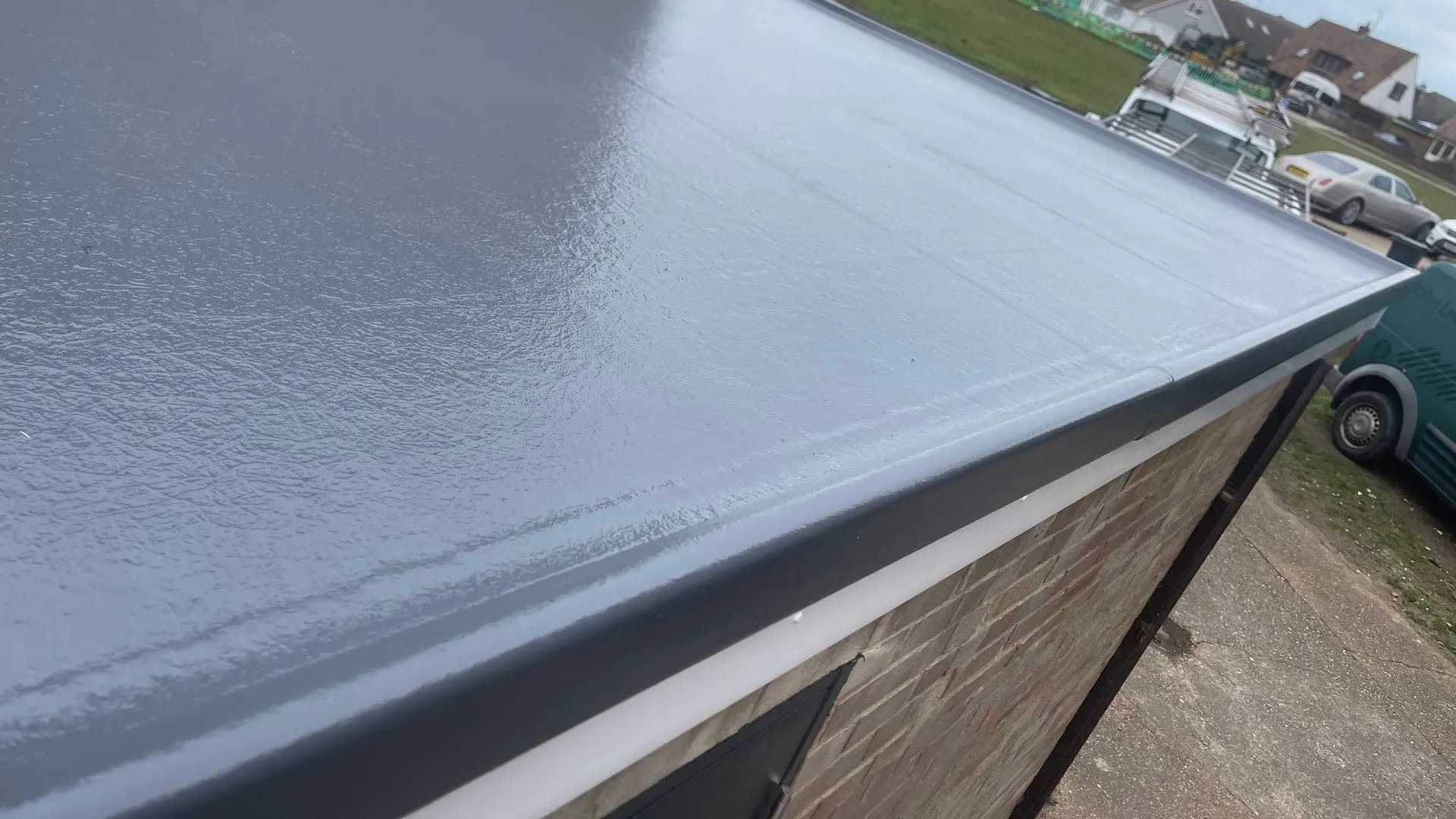
GRP fibreglass cures into a single seamless membrane across the whole roof, up every upstand and into every outlet. There are no laps, no welds and no seams — so there is nothing for water to get under and nothing for the wind to lift. Dean is a RESTEC Flexitec 2020 approved installer, so the roof gets registered with the manufacturer when it is finished.

  • RESTEC Flexitec approved installer
  • 20-year manufacturer guarantee
  • Seamless, no laps or welds
  • Walkable, 25–30 year system life
01 — Why fibreglass

The joints are the weak point. So we remove them.

GRP — glass-reinforced polyester — goes on wet. Chopped strand matting is laid out over the deck, saturated with catalysed resin, rolled out until every air pocket is gone, and then left to cure. What you end up with is not a sheet laid on your roof; it is one continuous, rigid membrane bonded to it, formed in place around every edge and every detail.

That is the whole argument for it. Felt has laps. Single-ply has welded seams. Both are perfectly good systems, installed properly. But every joint is a decision someone made on a roof in the weather, and joints are where flat roofs leak. GRP simply does not have any.

It also cures hard. You can walk on it, put a ladder on it, stand a bin store on it, use it as a balcony floor. On a garage roof someone actually uses, or a dormer cheek that will get climbed on the next time the gutters need doing, that toughness matters more than the spec sheet suggests.

02 — Where it fits

GRP is excellent. It isn’t universal.

We fit a lot of it, and we still talk people out of it when the roof isn’t right for it. Here is the honest comparison.

  • Ideal for GRP

    25–30 years

    Garages, dormers, balconies, porches, bay tops, small and mid-size extensions

    Roofs on a sound timber deck, with plenty of edges and upstands to detail, that need a hard walkable surface. This is where GRP beats everything else comfortably.
  • Consider EPDM instead

    30+ years

    Large single spans, and decks that flex or move

    GRP is rigid. On a big, lively deck that moves seasonally, a flexible membrane copes better. On most domestic roofs this is not a factor — on a long garden-room span it can be.

  • Consider a liquid system instead

    20–25 years

    Roofs that are sound underneath but leaking, and heavily detailed roofs

    GRP wants a new, clean, dry timber deck to bond to. Where the existing roof is structurally fine and a strip-out would be wasteful, a cold-applied RESTEC liquid system gets you a seamless finish without the tear-off.

  • Not the right call

    Wet or soft decks, and jobs booked in the wrong week

    Resin needs dry conditions and around 5°C or above to cure properly. It cannot be laid onto damp timber. Anyone offering to fibreglass your roof in the rain is about to sell you a roof that fails, and we will move a date rather than do that.

03 — The build-up

Four layers, in order, no shortcuts.

A GRP roof is only as good as what it was laid on and how hard it was rolled. This is the specification we work to.

  1. 18mm OSB3 deck, laid to falls

    New moisture-resistant decking, screwed rather than nailed so it cannot lift, with a 3mm expansion gap between boards and falls built in so water drains rather than ponds. GRP is only ever as stable as the deck under it, so this is not the place to reuse tired timber.

  2. GRP trims, bonded and bandaged

    Drip trims and edge trims fitted to every perimeter, then bonded and bandaged into the laminate rather than simply screwed on and relied upon. A trim that is only mechanically fixed is a joint, and we have just spent the whole page explaining what joints do.

  3. 450g chopped strand mat, fully consolidated

    Matting laid across the deck and up every upstand, saturated with catalysed resin and rolled until it goes clear. Rolling is the part that gets skipped when someone is rushing: any air left in the laminate is a dry patch, and a dry patch is a future blister.

  4. Pigmented topcoat

    A pigmented, UV-stable topcoat sealing the laminate as one continuous surface, in your choice of finish — dark grey is the usual, but it does not have to be. A non-slip aggregate can be worked into the topcoat where the roof will be walked on regularly.

04 — Worth knowing

Signs an existing fibreglass roof needs attention.

A well-laid GRP roof is close to maintenance-free. When one does start to go, it tends to announce it in these ways.

  • Hairline cracks along an edge or where the roof meets an upstand, usually movement in the deck below
  • Blisters or soft spots, which mean air or damp was trapped in the laminate when it was laid
  • A chalky, faded topcoat — cosmetic on its own, but worth recoating before it goes further
  • Water pooling and staying put, which points at falls rather than at the fibreglass
  • Any exposed matting, which needs sealing before UV and frost get into it
05 — What backs it

Approved installer, not just a roofer with a resin kit.

GRP is unforgiving of a bad install, which is exactly why manufacturers train and approve the people allowed to fit their systems. It is worth asking anyone quoting you what they are approved for.

  • Dean is a trained and approved installer for RESTEC Flexitec 2020, the flexible GRP system. That approval is not a badge — it is the thing that lets him register your roof with RESTEC on completion, so the materials carry their 20-year manufacturer guarantee alongside our own written workmanship guarantee. Only installers holding a current training ID can offer it.
  • Installed to the manufacturer’s specification, which is what a manufacturer warranty requires — not an approximation of it
  • Your roof registered with the manufacturer on completion, so the guarantee comes to you from them rather than resting on us alone
  • SIG Roofing One Warranty available on qualifying projects, giving you manufacturer-backed cover on top of ours
  • A 5–10 year written workmanship guarantee, plus a leak-free guarantee on new installations
  • Checkatrade vetted with 12 checks passed, CSCS carded and fully insured
06 — What it costs

What moves the price.

GRP is not the cheapest flat roof on day one and it is usually the cheapest across twenty years. What you actually pay comes down to these.

  • The area of the roof, and whether the existing deck can stay or needs replacing
  • How much detailing there is — upstands, outlets, rooflights and abutments take far longer than open span
  • Whether new falls need building in with firrings before the deck goes down
  • Access and scaffolding: a garage roof and a second-floor balcony price very differently
  • Stripping and disposing of the old covering
  • Finish options such as a non-slip aggregate or a non-standard topcoat colour

Free inspection, free written quotation, itemised, with the deck condition risk flagged before we start rather than discovered halfway through.

Get a Free Quote
07 — Recent work

Fibreglass roofs we’ve finished nearby.

Recent GRP and flat roofing jobs across Worthing and the surrounding postcodes.

08 — Common questions

GRP Fibreglass: the questions we get asked.

A correctly laid GRP roof on a sound deck typically lasts 25 to 30 years, and manufacturers generally rate the systems in that range. The deciding factors are the deck it was bonded to, whether the laminate was properly consolidated, and how the edges and upstands were detailed — not the resin itself.

Yes. It cures rigid, which is one of the main reasons to choose it over a membrane. Where a roof is going to be walked on regularly — a balcony, a roof terrace, a garage roof with a ladder on it every autumn — we can work a non-slip aggregate into the topcoat so it stays safe when wet.

A typical garage or extension roof is two to three days: strip out and deck on day one, laminate on day two, topcoat and trims to finish. The resin needs dry conditions and around 5°C or above to cure, so we plan them around the weather rather than forcing them through it.

No, and be wary of anyone who says it can. GRP needs to bond to a clean, dry timber deck — laid over old felt it has nothing to key into, and any moisture trapped underneath will blister it. If you want a seamless finish without a full strip-out, the right answer is a cold-applied liquid system, which is designed to overlay.

The laminate itself does not, but it is rigid, so it can crack if the deck beneath it moves. That is a decking and fixing problem rather than a GRP problem, and it is why we lay new 18mm OSB3, screw it rather than nail it, and leave expansion gaps between boards.

Dark grey is the standard and by far the most common, but the topcoat is pigmented so other colours are available. If the roof is overlooked from a window above, it is worth thinking about — it is the view you will actually live with.

Two separate things, and it is worth knowing the difference. Ours is a written 5–10 year workmanship guarantee plus a leak-free guarantee on new installations. On top of that, Dean is a RESTEC Flexitec 2020 approved installer, which means your roof is registered with the manufacturer on completion and the materials carry RESTEC’s 20-year guarantee issued direct to you. That second one is only available through installers holding a current training ID, so it is a fair question to ask anyone quoting you.

Get a price for a GRP roof.

Send a couple of photos and your postcode and Dean will come back to you personally, usually the same day, with an honest answer about whether fibreglass is the right call for your roof.

Free written quotation

Get a free quote.

Tell us about the problem and Dean will come back to you personally, usually the same day.

Address
55 Grafton Road, Worthing, BN11 1QY
Hours
Emergency call-out 24/7

9.84/10 · 73 reviews · Fully insured · Free written quotations

We’ll come back to you personally. No call centres, no automated chasing.