
Masters Roofing And Construction Ltd

Lead work & flashings

The oldest waterproofing there is. Done properly.

Chimney step flashings and front aprons, abutments, valleys, parapets, dormer cheeks and bay tops. Lead is the material that has kept British roofs dry for centuries, and it still outlasts everything sold as a modern alternative — provided the person fitting it knows what they are doing with it.

  • Code-appropriate milled lead
  • Bossed and dressed by hand
  • Chimney repointing undertaken
  • 5–10 year workmanship guarantee
01 — Why lead

The cheap alternatives are cheap for a reason.

Lead moves. That is the entire point of it. A roof expands in the sun and contracts overnight, a chimney moves differently to the roof it comes through, and the joint between them has to absorb that movement for decades without splitting. Lead does, which is why it is still specified on listed buildings when nothing else is allowed near them.

The self-adhesive flashing tapes you see on the shelf in a builders’ merchant do not. They stick beautifully on a warm dry day and then lift at the top edge two winters later, and once the top edge has lifted the whole thing is decoration. We take them off far more often than we put them on.

The other half of the argument is workmanship. Lead that is too long between joints will buckle and crack, lead that is nailed rather than wedged into a raked joint will tear, and lead dressed over a dirty or unraked mortar bed will simply come out. None of that is visible from the ground on the day it is finished, which is exactly why it happens.

02 — Where it goes

The places a house needs lead.

Six jobs, all of them the same material and all of them detailed differently. If you have a leak with no obvious hole in the roof, it is very likely one of these.

  • Chimney flashings

    40–60 years

    Any stack coming through a pitched roof

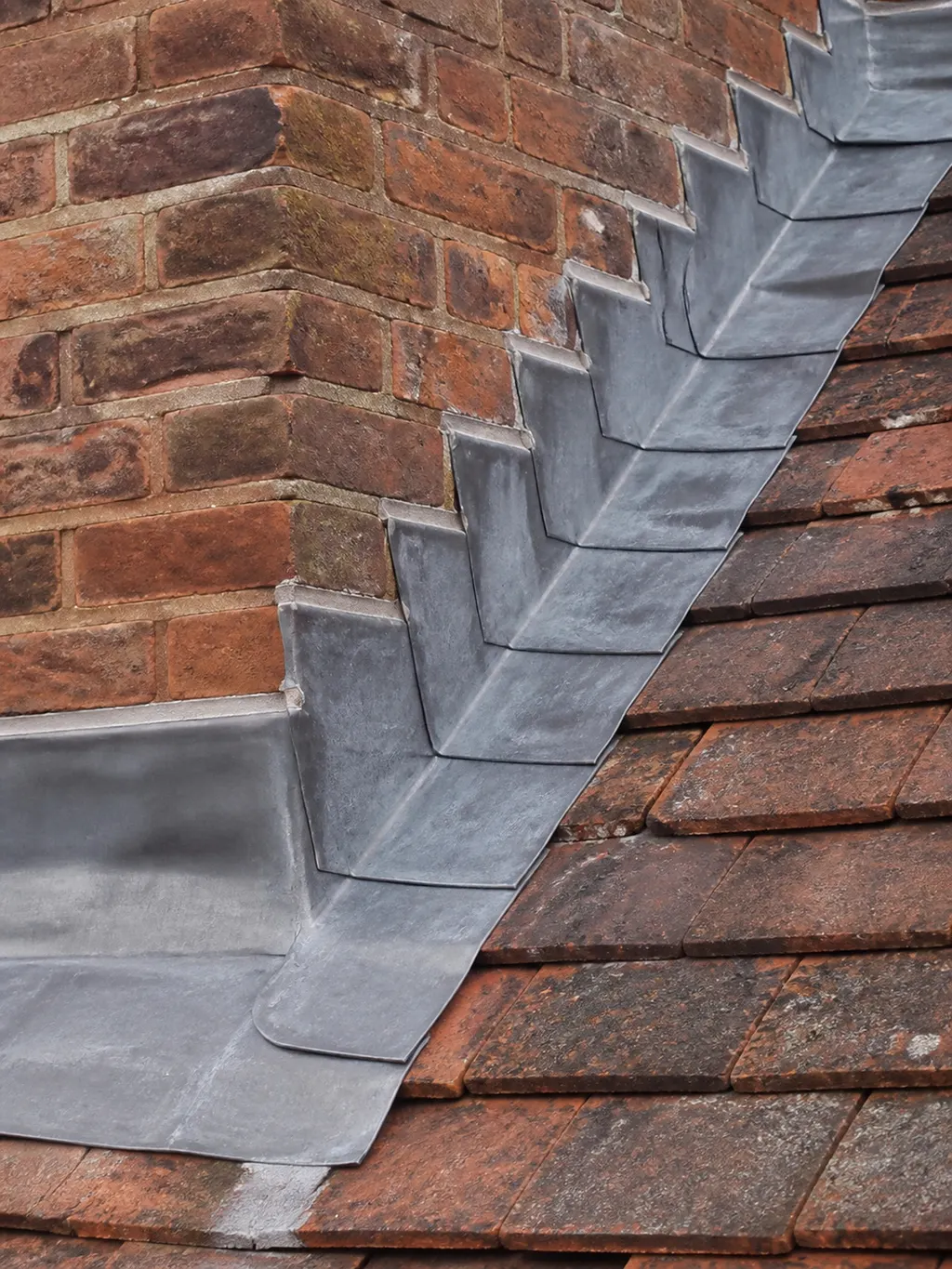
    A front apron across the face, step flashings raked into the brick courses up each side, soakers under the tiles, and a back gutter behind. Water tracking down a chimney breast inside is nearly always one of these having failed rather than anything wrong with the stack itself.
  • Abutments

    40–60 years

    Where a roof runs into a wall — extensions, lean-tos, dormer sides

    Step or straight flashing raked into the brickwork and dressed down over the covering, with a cover flashing where the detail needs one. Cement fillets are a very common sight on Sussex houses and a very common source of leaks: they crack because mortar cannot move and lead can.

  • Valleys

    40–60 years

    Where two roof slopes meet and both drain into the join

    Lead lined valleys carry a lot of water and take a lot of abuse. They need the right code, the right lap and the right length between joints — get any of those wrong and you get splitting exactly where you can least afford it.

  • Parapets and gutters

    40–60 years

    Terraces, older town properties and anything with a wall above roof level

    Lead-lined parapet gutters and copings, with drips and expansion joints where the runs are long enough to need them. Old ones fail at the joints and at the outlets, usually because they were fitted in lengths nobody would use today.

  • Dormer cheeks and bay tops

    40–60 years

    Dormer sides, bay window roofs, porch tops

    Small areas that carry a lot of detail, which is why they are so often the leak. Done properly they are effectively permanent.

  • Chimney repointing and rebuilds

    20–30 years

    Stacks with soft, missing or blown mortar

    Lead is only as good as what it is raked into. Where the mortar has gone soft we repoint the stack as part of the job — putting new lead into a joint that will not hold it is a waste of everybody’s money.

03 — How we do it

What separates lead that lasts from lead that does not.

None of this is visible from the ground once the scaffold is down, which is exactly why it is worth writing out.

  1. The right code for the job

    Lead is graded by thickness, and the code is chosen for what the detail has to do. Undersized lead in a valley or a long run will fatigue and split. We use milled lead to the code the detail actually calls for rather than to whatever is on the van.

  2. Joints in the right places

    Lead expands and contracts, so a run has a maximum length before it needs a lap or a welt. Exceed it and the sheet tears itself apart over a few seasons. Getting the piece lengths right is the least glamorous and most important decision on the job.

  3. Raked, wedged and pointed

    The mortar joint is raked out properly, the lead turned into it, wedged with lead clips and then pointed. Not surface-fixed, not siliconed, not stuck to the face of the brickwork with mastic and hope.

  4. Bossed, not patched

    Corners and awkward shapes are worked by hand into one continuous piece rather than being cut and joined with sealant. It takes longer and it is the difference between a detail that lasts forty years and one that lasts four.

  5. Patinated and left clean

    Fresh lead is treated so it weathers evenly rather than streaking white run-off down your brickwork or render for the first year. It is a small step and it is the one people notice.

04 — What it costs

What moves the price.

Lead is priced by weight and it is not cheap, so the quantity of it matters — but on most jobs the labour and the access matter more. These are the things that move it.

  • How much lead the detail needs, and at what code
  • Access — a bay top off a ladder and a chimney on a three-storey terrace are very different jobs
  • Whether the stack or the abutment also needs repointing before the lead can go in
  • How much of the surrounding roof has to come up to get the soakers in correctly
  • Whether the existing detail can be stripped cleanly or has been cemented over
  • The state of the brickwork, which decides whether we are raking a joint or rebuilding one

Free inspection and a free written quotation setting out exactly which details we are renewing and why. If the leak turns out to be somewhere else entirely, we will tell you that instead of selling you lead.

Get a Free Quote
05 — Recent work

Lead from jobs across Sussex.

Chimneys, abutments, valleys and dormers from a range of recent Masters jobs, plus a couple of frames from the bench.

08 — Common questions

GRP Fibreglass: the questions we get asked.

Usually not the stack itself — it is nearly always the flashing where the stack passes through the roof. The front apron, the step flashings up the sides, the soakers under the tiles or the back gutter behind will have failed, or somebody has cemented over the lot at some point and the cement has cracked. That is a flashing job, not a chimney rebuild, and it is a great deal cheaper.

We would rather not, and we will tell you why before you decide. Self-adhesive tapes rely on the bond at the top edge, and once that lifts — which it does, because the wall and the roof move differently — the whole thing is decoration. There are situations where a tape is a reasonable temporary measure. There are very few where it is the right permanent answer.

Correctly specified and correctly fitted, forty to sixty years is normal and considerably longer is common — there is lead on British churches that has been up for centuries. What kills it early is the wrong code, runs that are too long between joints, or being nailed to the face of a wall instead of raked in.

Yes, and on a lot of jobs it is part of the same visit. New lead has to be raked into a sound mortar joint and wedged — if the mortar has gone soft or is missing, there is nothing to hold it. We will tell you at survey whether the stack needs repointing before the lead goes in.

Lead theft is real but it is far more of a problem on churches and large commercial roofs than on domestic flashings, where the quantity is small and awkward to remove. If you have a large area of lead at low level and you are worried about it, say so at survey and we will talk through what can be done.

New lead oxidises and the first rains carry a chalky white run-off down whatever is below it. It is harmless and it stops once the lead has weathered, but it looks alarming on render or light brick. We patinate new lead as standard specifically to avoid it — if somebody has fitted lead on your house and skipped that step, this is why.

Get the flashing looked at before the plaster goes.

Send a photo of the chimney or the wall where the water is coming in and Dean will tell you what he thinks it is, usually the same day. Inspections and written quotations are free.

Free written quotation

Get a free quote.

Tell us about the problem and Dean will come back to you personally, usually the same day.

Address
55 Grafton Road, Worthing, BN11 1QY
Hours
Emergency call-out 24/7

9.84/10 · 73 reviews · Fully insured · Free written quotations

We’ll come back to you personally. No call centres, no automated chasing.